AI in calibration
Pennies on the Dollar:Why AI Will Never Cost More Than Your Calibration Technician
AI will not replace the calibration technician. It will make the best technicians significantly more productive — and raise the floor on what "standard" lab capability looks like.

Pennies on the Dollar:
Why AI Will Never Cost More
Than Your Calibration Technician
A data-driven look at wages, token economics, and the coming transformation of the calibration lab — and why the ROI question isn't what you think it is.
There's a question circulating in calibration labs and metrology departments right now, and it deserves a straight answer: Will AI augmentation tools eventually cost as much as the technicians they're meant to support?
The short answer is no — not even close. But the more interesting story is what that cost asymmetry means for lab economics, workforce roles, and how you should be thinking about AI adoption right now.
Section 01
Where the Industry Stands on Wages
Let's start with the numbers that matter most: what calibration technicians are actually paid in 2026.
$62k- avg metrology tech salary / year
$30- avg hourly rate calibration tech
$83k- cal tech III (senior) average
$42–48- fully burdened cost per hour
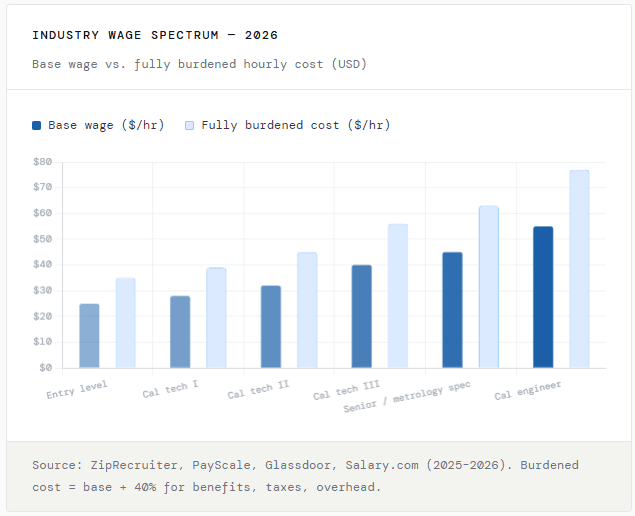
The wage ladder in calibration is compressed. From entry-level ($25/hr) to a senior Calibration Technician III ($40/hr) spans roughly 60% over a full career. The highest-paid roles concentrate in aerospace and defense (Boeing, Lockheed, Northrop Grumman), pharma/biotech (Genentech, GSK), and government labs — where median total pay reaches $70,000–$72,000/year.
What these figures don't capture is the true cost to a lab. Once you factor in employer-side payroll taxes, health insurance, PTO, training, certification maintenance, and overhead allocation, a $30/hr technician costs the organisation closer to $42–$48/hr. That's the number that matters when you're evaluating any augmentation tool.
Section 02
The Token Math That Should Change How You Think About AI
AI pricing in 2026 is based on tokens — roughly 750,000 words per million tokens. The leading models used for industrial and technical augmentation are priced as follows:
Claude Haiku 4.5:$1 input / $5 output per million tokens — fast, ideal for high-volume document and lookup tasks.
Claude Sonnet 4.6:$3 input / $15 output per million tokens — balanced general use, the workhorse for most calibration workflows.
Claude Opus 4.6:$5 input / $25 output per million tokens — complex reasoning, uncertainty analysis, standards interpretation.
A typical calibration lab interaction — a procedure lookup, uncertainty budget check, certificate draft review, or standards query — runs roughly 1,000–3,000 tokens total. At Sonnet 4.6 rates, that's $0.02–$0.05 per interaction.
"A technician doing 50 AI-assisted tasks in a day — a heavy user — generates roughly $1.13 in token costs. Their fully burdened labor cost for that same day: $240–$340."
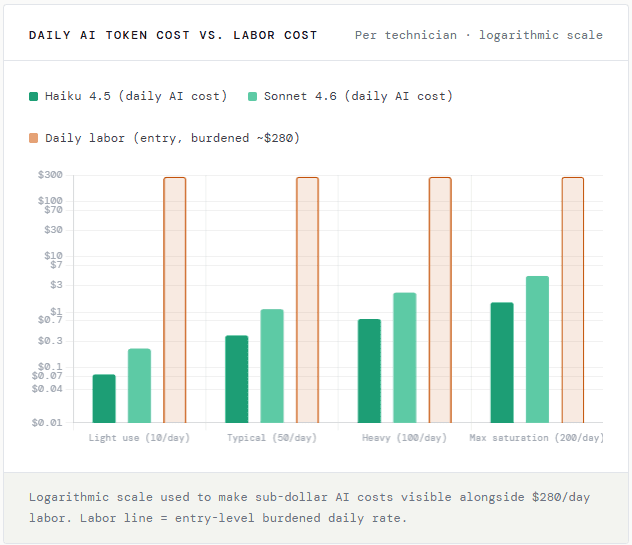
Even at maximum saturation — 200 AI interactions per day, long-context prompts, complex outputs — daily AI spend stays under $15 per technician. That's less than 6% of a single day's fully burdened labor cost, and that ceiling is shrinking as model efficiency improves and provider competition intensifies.
Token prices have dropped dramatically over the past two years. What costs $3/million tokens today may cost $0.50/million within 24 months. AI token costs will not surpass technician wages. The trend is in the opposite direction.
Section 03
If It's Not the Cost, What's the Real Economic Story?
The cost question is almost a distraction. The real economic transformation from AI adoption in calibration labs plays out across three compounding dimensions.
1. Throughput expansion
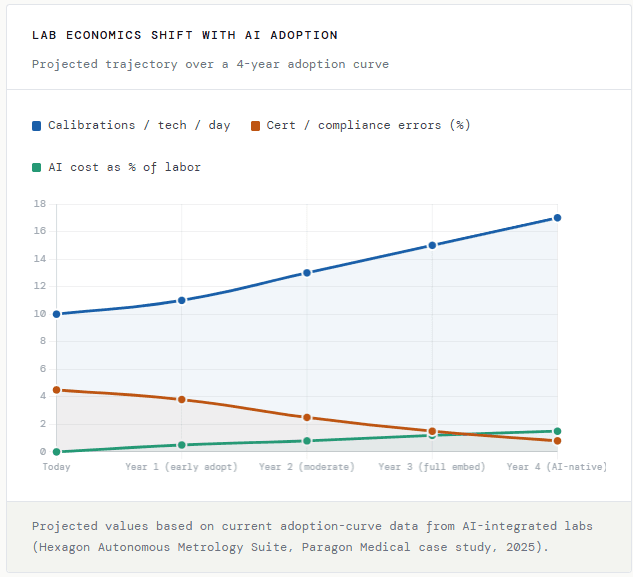
An AI-augmented technician moves faster through documentation, uncertainty analysis, procedure retrieval, and compliance verification. Conservative estimates suggest a well-integrated AI workflow can push a technician from 10 calibrations/day to 14–17 as tooling matures — same headcount, up to 70% more revenue capacity. For a lab running on thin margins with a backlog problem, this is the number that unlocks growth without new hires.
2. The Calibration-as-a-Service shift
AI is enabling a structural change in how calibration services are delivered. Organisations are adopting cloud-connected, AI-assisted platforms that integrate remote monitoring, predictive drift alerts, and digital certificate management. This moves the economic model away from pure time-and-materials toward subscription-based service models — changing how labs price their services and compete for contracts.
3. Role redefinition and the case for wage growth
Here's the counterintuitive conclusion: AI adoption in calibration labs argues for higher wages for the technicians who remain, not lower.
"Technicians are shifting into roles as data interpreters, systems managers, and quality intelligence analysts — positions that demand higher analytical skills and command higher compensation."
The technician who can work alongside AI tooling, validate AI-assisted uncertainty budgets, manage calibration data pipelines, and maintain traceability in a digital-first environment is more valuable than one who cannot. Labs that invest in upskilling their workforce alongside AI tools will have a competitive advantage in both talent retention and service quality.
Section 04
The Real Barriers to Adoption — and They're Not Cost
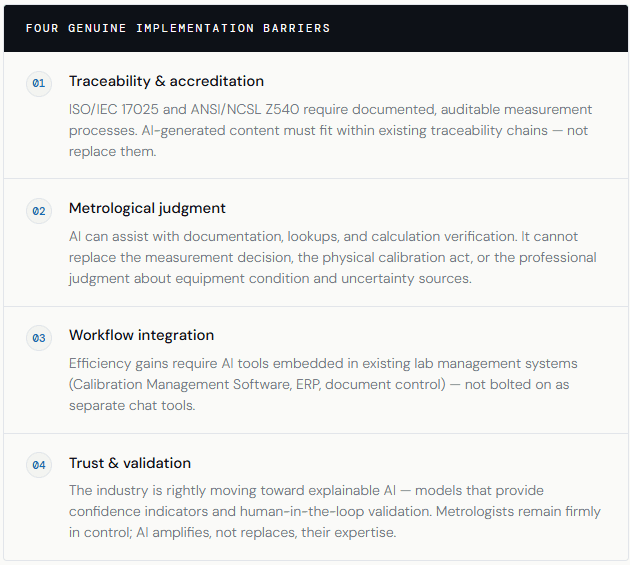
These are real considerations, but none of them are "AI is too expensive." The cost argument is settled. The implementation argument is where labs should be focusing their energy.
The Bottom Line
The economics of AI augmentation in calibration labs are almost absurdly favourable. At sub-1% of fully burdened labour cost, the ROI question isn't "can we afford this?" — it's "what do we do with the capacity we unlock?"
The labs that will define the next decade of calibration services aren't waiting to see if token prices come down further. They're figuring out how to integrate AI tooling into their workflows, train their technicians as data interpreters, and restructure their service models around the throughput advantages AI enables.
AI will not replace the calibration technician. It will make the best technicians significantly more productive — and raise the floor on what "standard" lab capability looks like.
That's the economic transformation worth planning for.
Sources: ZipRecruiter (March 2026) · PayScale (2026) · Glassdoor (Oct 2025) · Salary.com (Jan 2026) · Anthropic API Pricing (March 2026) · Metrology News — "Metrology 2026: From Measurement to Intelligent Action" · Fluke / MSC Direct — "Imagining the AI-Fueled Future of Metrology" · Hexagon — "Autonomous Metrology Suite" press release (2025) · Acta IMEKO — "Intelligent robotic positioning through AI-enhanced metrology" (Sep 2025)